Today's blog post will be a book review by a Japanese author, Haruki Murakami. (I haven't finished Catcher in the Rye yet.) I was first introduced to this author by my friend Amanda, (click for her blog) when I was a wee lassie in Year 9. (Ok, maybe not that wee lassie.)
I started off with Kafka on the Shore and even now I do not fully understand it. Mr. Murakami is well known for his use of surrealism that ties in with his themes of human life, emotions and the philosophy of existence.
My friend lent me this shorter novel of his (it's only 200 pages) so I finished it in a few days. I have read some other Murakami novels since Kafka, and this would be the latest.
It chronicles the life of Hajime, a child born in 1951. Being an only child, he had only one friend, Shimamoto, a girl. But they lost touch when he moved away. Growing up into his teens and then his twenties, we see Hajime gain a better grasp of how his life is progressing, but yet we see his selfish side, in a few chapters where he wounds his high school girlfriend emotionally.
Upon graduation he gets stuck in a dead-end job, aimless and directionless in his life for 8 years, until he meets Yukiko and marries her, settling into family life with two daughters, running a jazz bar.
Then one day, Shimamoto comes back. The book explores his feelings and his inability to forget his first love. All this paves the way to infidelity, and at the same time, some self-discovery. I have noticed that most of the Murakami novels I've read deal with self-discovery, and how you don't really know yourself until you learn from experience.
Also, most of the protagonists in his books are average, decent males who are searching for something, some inner fulfillment. This somewhat fits Hajime here. As a female teenage reader, I can't really relate to Hajime's mid-life crisis, but I do suppose it is an artistic expression of what goes through men's minds at this point. These days divorces are so common and to me, having an artistic impression of infidelity somehow makes the irrationality of human emotional motivation easier to tolerate.
Hajime's selfishness is highlighted well, and is clearly seen in a short conversation with his wife, where she points out that he assumes he knows what she is thinking and that he has never really asked her a question about anything. You'd think that she would be outraged, but instead, she just takes the blow, quietly stating to him that she feels the pain but nothing else.
I think that deep down, Hajime is afraid of being alone, maybe alone with no one but himself for company. He describes a "force" within him that he cannot overcome. The force of a selfish desire for his first love, perhaps? Someone he may never have. Here I think again of Buddha's words, "Desire is suffering."
While this book does not have much of that ethereal glow that I savour while reading other Murakami works, (I have read about a Sheepman, and fish raining from the sky) I found it enjoyable, because you could see the feelings point-blank. Sometimes the misty metaphors that he uses in other books take a while to adjust to an interpret. It seems like a straightforward story, but because of the way in which Hajime's feelings are described, like something blurred, something which lurks incessantly, it isn't that simple.
In conclusion, I was able to feel Hajime's desperation, and was relieved that he found some closure at the end of the book. Murakami's language is simple--even in Japanese (I read the English translation), but the things he conveys are not. South of the Border reads a bit like a dream, yet at all times you are made aware of reality lurking behind it. Then Murakami asks you: what is reality?
Wow, I've been rambling on. I can't stop soon enough when I talk about books. This isn't a serious review, though, I just want to expound on my thoughts on the book. Try a Murakami sometime. You may be surprised, or you may be disgusted, or you may love it, but I think it would be a unique experience.
A little something I use to rant and express opinions. Hopefully in a funny, entertaining way. Welcome to my continuum! It's in my head, please excuse the mess. =D
Showing posts with label book reviews. Show all posts
Wednesday, October 6, 2010
Review: South of the Border, West of the Sun
Labels:
book reviews
Tuesday, September 14, 2010
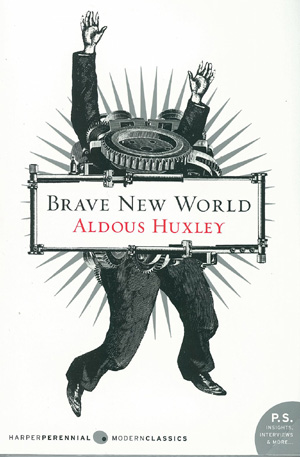
Brave New World: A Dystopia of Pleasure?
Today's post will be a book review about the novel "Brave New World" by Aldous Huxley. It's a pretty iconic book, and if you haven't read it yet, please give it a shot. I'm just going to post my thoughts about it, and its underlying message.
To give an intro, Brave New World is set in the 2500s, where everyone lives under a "World State" and is perpetually happy. Humans are divided into five classes: Alpha, Beta, Gamma, Delta and Epsilon. Gamma to Epsilon classes perform more menial work, and Alpha and Beta are more upper-caste.
No one is born the normal way; everyone is "manufactured" via IVF through sperm and eggs. Sometimes eggs are "Bokanovskified" so that they produce batches 96 identical individuals(for Gammas to Epsilons). Promiscuity is promoted and everyone is encouraged to "have one another". No one ages. At sixty you still look young. The word "mother"is a swear word, and "father" is a joke. The idea of marriage, family, and passionate relationships are over.
Kids are conditioned by having subliminal messages pumped into their ears during sleep. The first part of the story deals with life in this society. We are introduced to Bernard Marx (who somewhat questions the civilisation) and Lenina Crowne (who is a typical female).
The second part deals with Bernard and Lenina going to a Savage reservation in Mexico (where people still live lives much like the native American Indians in my opinion). They find a white man who was born there; he is John, known as "Mr. Savage" when he returns to London with Bernard, along with his mother, Linda, who has actually aged without the chemicals to keep her young.
The third part of the book deals with the Savage living in London and the struggles he faces with this "Brave New World". I won't say more here, except that in order to truly appreciate the many layers of this world you have to read the book yourself.
My opinions on this dystopian world:
--It has some elements of early 20th century advancement, such as mass production, being written in 1932. Perhaps the most eerie one is the "baby in the bottle" way of manufacturing people and then putting them on an assembly line, where they have alcohol put into their bottles to dumb them down and exposed to heat or cold so that they can be adapted to future job conditions.
--Consumption and capitalism seem to play an important part. Deltas are conditioned to like certain things so that they would spend more on them, supporting the economy. Not very unlike our current world, where we have to "keep up with trends" and new products are always grazing the surface of the market.
--People are brainwashed since young to like their place in the Alpha-Epsilon caste, and there is always a "soma" drug to keep you happy should you ever feel unpleasant emotions. Everyone is happy. This is something the Savage questions. Given my never-ending quest to truly understand and live with human emotions, I couldn't help but be interested in this part. A world where everyone is happy?
It is ideal, but then we would lose some semblance of humanity. For what is there to work for, if everything you want is given to you? If happiness is something shaken out of a pill-box?
There is a part when the Controller reads a paper by Bernard describing a suspicion that the ultimate goal is not a stable Society, but perhaps some expansion of human intelligence and consciousness.
But then, he shakes his head and says "This cannot be published."
After reading the notes at the back of the book, I found out that Aldous Huxley was actually quite interested in this human intelligence and consciousness expansion. I am, too, after reading about "Boltzmann brains." These are supposedly random events where a conscious entity supposedly "pops up" in the Universe. But I digress. Wikipedia it if you want, it's something abstract that you can wrap your mind around.
All in all, I enjoyed the book, and am impressed at the scope of Mr. Huxley's imagination. It leaves me a little shaky because it reminds me of human beings' propensity for evil, and that some small parts of the book may already be showing up in our society, like consumerism. Maybe that's why I like sci-fi--it's full of "what ifs" and predictions of the future of humankind. Good as food for thought.
I know this is a long post, so thanks for putting up with it. I have a huge stack of other sci-fi and general fiction that I'm trying to finish. The next book review I think will be about "Catcher in the Rye" by J.D. Salinger. I'm looking forward to it.
At the risk of sounding like I'm spreading educational propaganda for young kids, Reading is Fun!
Labels:
book reviews
Subscribe to:
Posts (Atom)